Rediscover Clean Highlights Trinity Guardion's Innovative Hospital Bed Barrier Solutions
Protecting patients — and the hospital's investment in its mattresses.
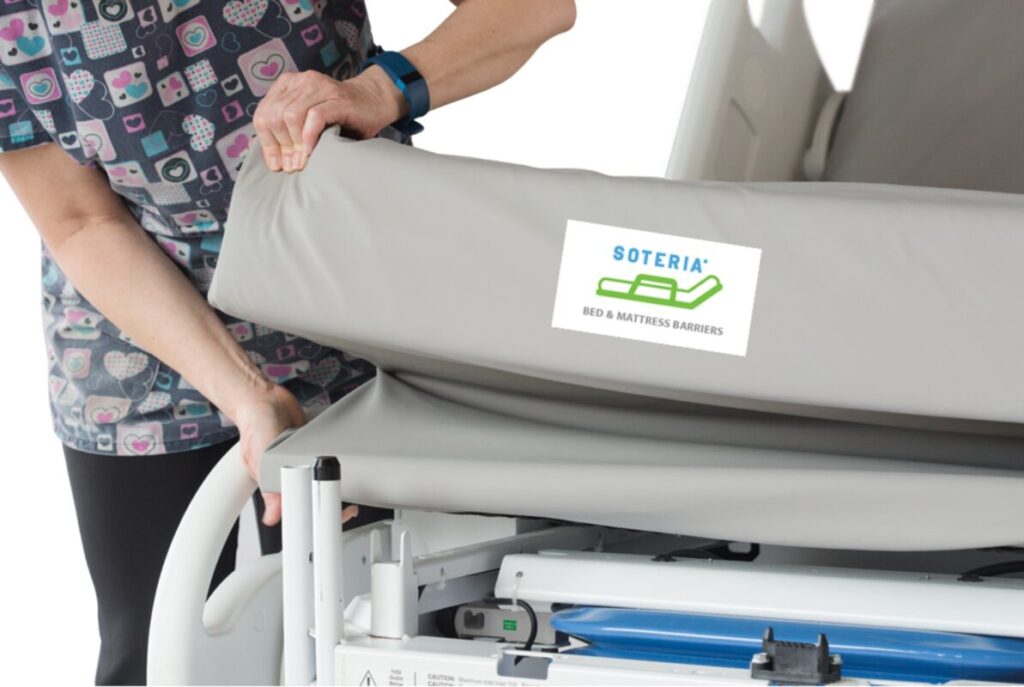
When healthcare leaders discuss infection prevention, attention usually turns to hand hygiene, environmental cleaning, disinfectants, and high-touch surfaces. But one of the most frequently used patient touchpoints — the hospital mattress — is often overlooked.
Rediscover Clean is pleased to highlight Trinity Guardion and its Soteria® Bed Barrier solutions: an innovative approach designed to help healthcare organizations protect mattresses and bed decks, simplify reprocessing, and strengthen patient-safety practices.
It also presents an important value-analysis opportunity. Hospitals can spend thousands — and across an entire health system, potentially hundreds of thousands of dollars — replacing damaged or contaminated mattresses. Preventing unnecessary mattress damage can protect a significant capital investment while reducing the operational disruption of removing and replacing equipment.
More Than a Mattress Cover
The Soteria Bed Barrier may resemble a fitted sheet, but it is an FDA 510(k)-cleared, Level 4 microbiological barrier designed to protect the hospital mattress and bed deck from patient soiling.
It's worth understanding an industry reality here: there are no disposable mattress covers designed for hospital mattresses that don't, in some way, affect the clinical effectiveness of the mattress beneath them. That's a meaningful limitation when the surface underneath a patient is part of the care environment.
Unlike a disposable cover, Soteria is launderable and reusable. Its validated laundering and inspection process removes more than 99.9999% of vegetative bacteria and mycobacteria, while also providing spore reduction equivalent to high-level disinfection.
The system can help healthcare organizations:
- Reduce mattress and bed-deck contamination
- Protect mattresses from fluids, moisture, and patient soiling
- Standardize the mattress-reprocessing process
- Support compliance with manufacturers' instructions for use
- Reduce the time Environmental Services teams spend reprocessing beds
- Limit damage from improper disinfectants or cleaning practices
- Extend the useful life of hospital mattresses
- Reduce avoidable mattress-replacement expenses
- Strengthen documentation and process accountability
Soteria also includes an RFID-enabled, cloud-based inventory platform that helps facilities monitor barrier availability, utilization, replacement, and reprocessing compliance.
The Hidden Cost of Mattress Replacement
Hospital mattresses represent a much larger financial investment than many people realize. Beyond the purchase price, replacement can involve inspection time, infection-prevention review, procurement activity, storage, transportation, removal and disposal of the damaged mattress, and the temporary loss of an available bed.
Mattresses are removed from service for cracks, tears, staining, fluid ingress, weakened seams, or damage caused by incompatible cleaning chemicals and repeated disinfection. And once the integrity of the mattress cover is compromised, cleaning the exterior surface may not address contamination that has entered the mattress itself.
This is a bigger blind spot than many teams realize. Reports in the FDA's MAUDE database — the agency's public adverse-event reporting system — describe mattress covers that looked perfectly fine on the outside but, once opened, were found to have fluids trapped inside. Staff simply cannot see all the damage by visual inspection alone, and what can't be seen can put patients at risk. Reporting related to mattress and cover integrity has been increasing in recent years, which makes this an issue worth getting ahead of.
The scale of the problem can be striking. A poster presented at a WOCN (Wound, Ostomy and Continence Nurses Society) conference reported that one East Coast hospital tested its beds by placing a weight in the center of each mattress and pouring water over the surface — and found that 98% of its mattresses had failed. Damage like that often goes unbudgeted, turning what should be a planned capital cycle into a sudden, unplanned expense.
Across hundreds or thousands of hospital beds, even a modest rate of premature replacement becomes a substantial, recurring expense.
That's why the Soteria Bed Barrier is best considered through a multidisciplinary value-analysis process — one involving Environmental Services, Infection Prevention, Nursing, Clinical Engineering, Supply Chain, Finance, Laundry Services, and Risk Management.
A complete evaluation should consider:
- Current annual mattress-replacement spending
- The number and types of mattresses removed from service
- The primary reasons for mattress replacement
- The average useful life of existing mattresses
- Labor required to clean and reprocess beds
- Room-turnaround time
- Costs associated with mattress inspection, storage, and disposal
- Potential improvements in mattress life and asset protection
- Infection-prevention and regulatory benefits
- The overall return on investment
The question isn't simply, "What does the barrier cost?" The more meaningful question is, "What is the total cost of continuing to replace mattresses prematurely while relying on a difficult-to-standardize manual reprocessing process?"
Protecting Healthcare's Most Vulnerable Patients
Trinity Guardion has extended this technology to neonatal care through the Soteria® Infant Mattress Barrier.
Designed for infant warmers and NICU incubators, the barrier provides a protective physical layer between the infant and the mattress, while helping prevent fluids and microorganisms from passing through its surface. It meets AAMI PB70 Level 4 and ASTM F1671 barrier standards, is biocompatible, and is designed not to introduce X-ray artifacts.
The reusable barriers are collected, professionally laundered using a validated process, inspected for material integrity in a clean-room environment, individually packaged, and returned to the facility ready for use.
Neonatal mattresses and their specialized equipment can represent a particularly important investment. Protecting these surfaces supports both the safety of highly vulnerable patients and the hospital's responsibility to properly maintain its clinical assets.
Supporting Environmental Services, Infection Prevention, and Value Analysis
Technology alone does not replace proper cleaning, inspection, or adherence to manufacturers' instructions for use. But the right technology can make critical processes more consistent, measurable, and easier for frontline teams to perform correctly.
That's what makes the Soteria system worth exploring. It connects Infection Prevention, Environmental Services, Nursing, Clinical Engineering, Laundry Services, Supply Chain, and Finance around shared objectives:
- Protect the patient
- Protect the mattress
- Simplify the process
- Reduce unnecessary replacement costs
- Extend the life of hospital assets
- Validate that the process is being followed
At Rediscover Clean, we believe innovation should solve real operational challenges and deliver measurable value. Trinity Guardion's approach aligns with our commitment to helping healthcare organizations educate their teams, improve processes, introduce meaningful innovation, and validate performance.
If your organization is facing high mattress-replacement costs, premature mattress damage, challenges with bed-reprocessing consistency, or a need for additional protection in neonatal care, Rediscover Clean can help facilitate a review of your current practices and introduce your team to Trinity Guardion.
That evaluation can include a review of replacement costs, mattress life, workflow, labor requirements, and potential return on investment — helping your organization determine whether the Soteria Bed Barrier is both a patient-safety solution and a sound financial decision.
To learn more or schedule an introductory value-analysis conversation, contact Rediscover Clean.
Rediscover Clean
Engage. Educate. Validate. Innovate.
Internal References
Frequently Asked Questions
What is the Soteria Bed Barrier?
The Soteria Bed Barrier is an FDA 510(k)-cleared, Level 4 microbiological barrier from Trinity Guardion that protects a hospital mattress and bed deck from patient soiling. Unlike a disposable cover, it is launderable and reusable, with a validated laundering and inspection process.
Does the bed barrier replace routine cleaning and mattress reprocessing?
No. Technology alone does not replace proper cleaning, inspection, or adherence to manufacturers' instructions for use. The barrier is designed to make reprocessing more consistent and measurable and to protect the mattress — complementing, not replacing, established practices.
How can bed barriers reduce hospital mattress-replacement costs?
Mattresses are frequently removed from service due to fluid ingress, staining, tears, or damage from incompatible cleaning chemicals — and much of that damage isn't visible from the outside. By protecting the mattress and bed deck from soiling and standardizing reprocessing, a barrier can extend mattress life and reduce avoidable replacement expense, a cost best evaluated through a multidisciplinary value analysis.
Why can't staff just inspect mattresses visually?
Visual inspection has real limits. Reports in the FDA's MAUDE database describe covers that appeared intact but held fluids inside once opened. Because damage can be hidden beneath a normal-looking surface, protection and a standardized inspection process matter alongside routine checks.
Is there a version for neonatal care?
Yes. The Soteria® Infant Mattress Barrier is designed for infant warmers and NICU incubators, providing a protective layer between the infant and the mattress. It meets AAMI PB70 Level 4 and ASTM F1671 barrier standards and is biocompatible.
Ready to evaluate your mattress protection and replacement costs?
Schedule a value-analysis conversation with Rediscover Clean to assess your facility's potential savings and protection strategy.